


There are several opportunities in interior design beyond the standard job. If you’re interested in entrepreneurship, you may look into furniture collections, home styling, material consultancy, visual merchandising, the production of design content, or independent consulting.
Digital platforms provide designers greater opportunities to showcase their work and network with potential clients and coworkers.
So, the interior design course in Jaipur career route might be different. Students may start their studies by experimenting with many styles, before deciding the kind of settings, materials, colors or topics that best appeal to them. Education of interior design course may give a place where such investigation can be assisted.
What to Do After Studying Interior Design Career Options
The interior design field provides several career options, since the economy needs competent professionals in a wide variety of fields. With experience, talented craftsmen may go on to larger projects, specialize in specific types of interiors, or open their own design business. That’s why it’s a serious option as a place to learn interior design.
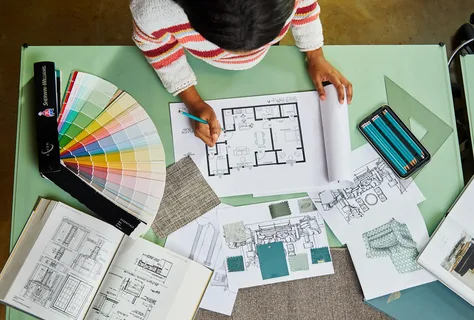
A personal design identity does not mean subscribing to one style. Or it might just be a way a designer solves problems. Portfolio development is a very important aspect of this process. A systematic portfolio might demonstrate the progression of concepts from research to final design. Sketches, drawings, elevations, material studies, mood boards, models, renderings and final projects are all ways of showing what a student can produce.
A excellent portfolio will also demonstrate your problem solving talents. Students explore the relationship between historical and current design, and formulate their own creative points of view. So, by opting for interior designing courses in Jaipur you may have opportunities to study not only in the classroom but also from the city’s distinct visual and cultural surroundings.
The Creative Realm of Interior Design
Interior Design is sometimes confused with merely decorating a room. In reality it’s a much deeper process of knowledge of people, places, materials, function, esthetics and technology needs.” They have to think about how a space is to be used, how people will move through it, the effect of natural and artificial light and how different characteristics may be used together to make a nice place.
They are free to consider contemporary, classic, minimal, industrial, eco, eclectic and other forms of design. Experimenting helps people find their own likes and to develop a personal design language.
A pupil’s creative development may be greatly affected by the environment in which they study. For an aspiring designer, Jaipur is of great significance, because of its unique combination of history, architecture, craftsmanship, color and current development. In Jaipur interior design school, students will be taught about craftsmanship. Future designers will know the importance of detail and how handmade details can improve modern houses.
These concepts give order for creativity. After pupils have a good understanding of the basics, they may experiment with other styles and ideas without losing functionality and visual harmony. This foundation becomes useful in all phases of their future design professions.
Furniture Lighting Color Materials Texture Explore
Color is a major factor in creating an interior’s ambiance. It may brighten or warm up a space, making it seem calmer or more active or more sophisticated. The drawings are also quick enough that designers may explore a number of options without too much investment in any one notion.
As a concept develops, technical drawings become more and more vital. Elevations indicate vertical connections and finishing. Sections may reveal the construction and spatial linkages that may not be obvious on a basic plan. During the execution phase, detailed drawings may provide information needed.
Digital instruments are opening up new options for interior designers. But technology is only an element of the design process. A digital tool may facilitate an idea, but the quality of that concept relies on imagination, investigation, observation and problem solving. Students acquire conventional and digital abilities for the flexible and professional communication of thoughts.
Students who have a grasp of sustainability might approach future initiatives from a more holistic point of view. “They can think not just about what an interior looks like when it’s complete, but how it functions and ages and adapts and ultimately changes over time.”
Create Your Own Creative Identity as a Designer
One of the most fascinating aspects in learning interior design is finding one’s own creative personality. Students start out by learning the ideas and styles that already exist but with experience may come up with their own method of understanding environments over time.
An workplace should help workers by addressing communication, focus, cooperation, mobility and comfort. A retail environment has to think about how people arrive, browse items, navigate displays and make buying choices. A restaurant has to combine the needs of the eating comfort with the practical needs of personnel and service areas.
Get Hands-On Experience With Creative Design Projects
The significance of interior design education is amplified if the students can use the gained knowledge via actual projects. Students learn that there is more than one way to do interior design via a variety of project kinds. Each place has its own purpose, users, constraints and possibilities. Designers will need to adjust their creative ideas to the needs of each project.
Hands-on projects also educate pupils to deal with constraints. Organization needed for drawings, presentations, material research, revisions, meetings and project co-ordination. Good working habits developed in school assist pupils to be more equipped for professional obligations. Awareness of such tactics may also be used by designers to understand the interaction between design ideas and the people who construct real items and finishes.
This may also help pupils to think about regional identity. Rather of seeing interior design as a series of foreign trends, prospective designers are able to examine how local culture, climate, materials, architecture and lifestyle impact the way rooms are designed. Such insights may provide the basis for thoughts that seem more contextualized, but remain current.
Summary
Digital modeling, virtual visualization, smart systems, novel materials and enhanced building processes are offering new possibilities. Designers that are interested and open to interior design course learning may stay up with these advancements. Ultimately, the path into interior design is a journey of change.
