


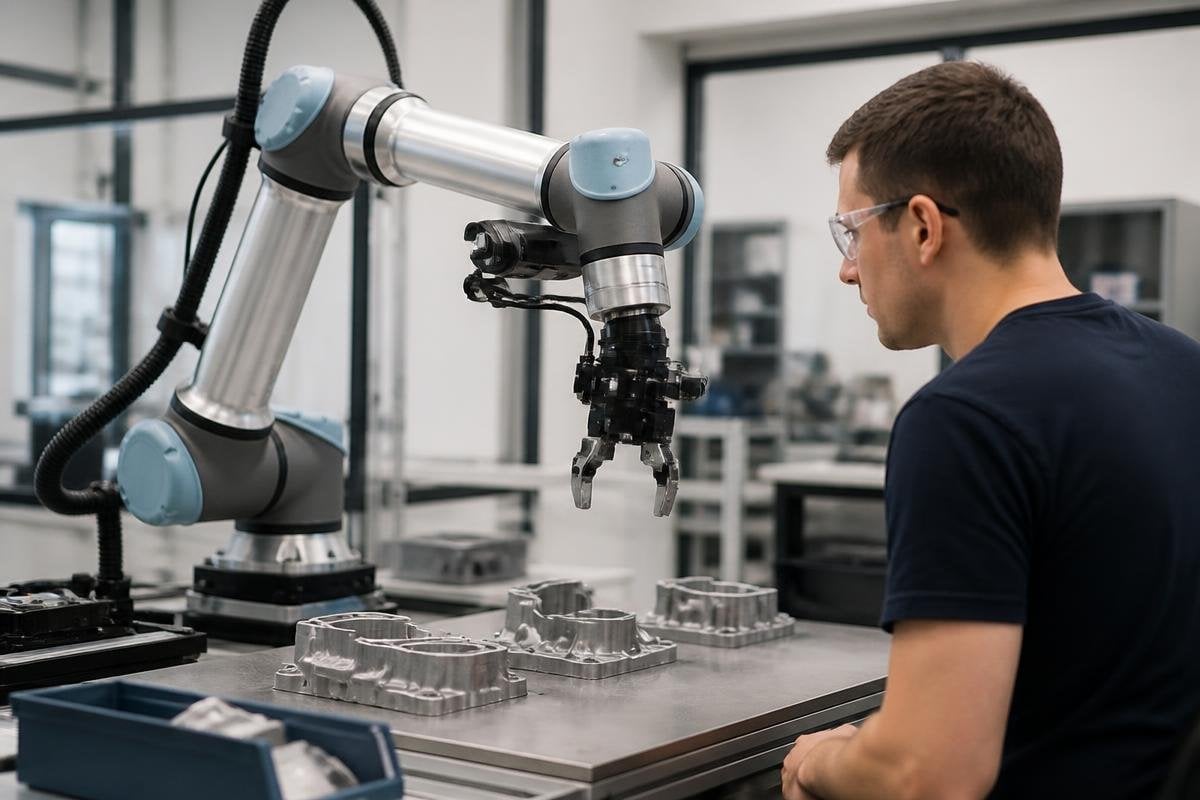
A robot arm used to repeat a fixed path and stop when the work changed. Newer systems can use cameras, force sensors, and software models to adjust their movements as they work. That shift matters when parts arrive in different positions or people share the same work area.
- Cameras help the arm find parts that are not placed perfectly.
- Force sensors let it detect contact instead of pushing blindly.
- Better software can change a task without rebuilding every motion by hand.
From fixed paths to sensed motion
Traditional robot arms follow programmed points. A technician teaches the arm where to move, how fast to travel, and when to open the gripper. It then repeats those commands with little knowledge of what its surroundings look like.
That method works well when the work stays the same. A production line with fixed trays and repeatable parts can use it for years. The problem starts when a part shifts, a box is missing, or a person enters the arm’s working area.
Sensors give the arm more information. A camera can locate an object, while force sensing can show that the gripper has touched it. The control software then compares what it expected with what it measured and changes the motion.
This does not give the arm human judgment. It gives the arm a larger set of signals to act on.
Software is doing more of the work
The hardware still matters. Motors, gearboxes, joints, cables, and grippers decide how much weight the arm can lift and how accurately it can move. Software decides how that hardware responds when the task does not match the original program.
Machine learning can help an arm identify parts from camera images or choose a grip from several options. The system needs training data, a defined task, and a way to stop safely when its confidence is low. A label on a software page does not prove that the arm can handle a production line.
Robot makers are also adding tools that let one program handle small changes in a task. An arm may detect that a part is a few millimeters away from its expected position and adjust its approach. That saves setup work for some jobs, but it does not remove the need for testing.
A few millimeters can decide whether an arm places a part or drops it. A report from Robot24.com that names the arm, software version, and test date gives the next section a firmer starting point.
Where smarter arms help
The biggest gain appears in tasks with controlled variation. A factory may use the same type of part while allowing small changes in position, surface, or orientation. The arm can then correct its motion instead of failing at the first mismatch.
This can reduce the time a technician spends teaching new positions. It can also help a company reuse an arm for more than one task. Those benefits depend on the sensors, the gripper, the software, and the quality of the test data working together.
Shared work areas need another layer of care. The arm must detect people and slow or stop when required. A system that reacts well in a clear test cell may need a different setup around shelves, carts, glare, dust, or changing light.
The limits are plain. A camera can misread a shiny surface. A force sensor can detect contact without knowing whether that contact is safe.
Software can choose a poor motion when it meets an object missing from its training data.
I’d judge a smarter arm by how it handles the first ordinary failure, not by how smoothly it completes a prepared demo.
A buying checklist
If you’re comparing robot arms for a real task, check these points before you compare software labels:
- Task range: write down the part sizes, surface types, weights, and allowed position changes.
- Sensor proof: ask for test results using your parts, lighting, tools, and work area.
- Failure response: check what the arm does when it cannot find, grip, or place an item.
- Setup time: measure the hours needed to teach a new part or change a work position.
- Safety setup: confirm the required scanners, limits, stops, guarding, and operator training.
- Open costs: include the gripper, cameras, software fees, integration work, and service.
A smarter arm earns its price when it handles the changes that used to bring production to a stop. The open question is how many of those changes it can handle without a technician taking over.
